
Open Educational Resources – Publishing
- Get inspired by the experiences of others. You can find various practical examples on edusources.
- Saxion lecturers have developed their own learning materials or MOOCs, including the toolboxes below.
- At media.saxion.nl, under Academies & Services, you’ll find various (public) videos developed by lecturers and staff.
- On the Media Xpert Centre channel, you’ll find all the productions developed by Saxion’s media team.
- There is a lot of information about and examples of open educational resources in the catalog of Saxion Library.
Coming soon …
Coming soon …
Publishing – frequently asked questions
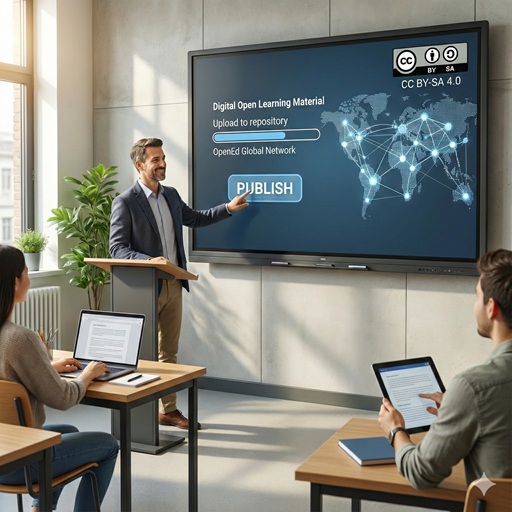
You can publish your digital open educational resources via platforms/repositories that are set up for sharing and reusing educational content. This allows fellow lecturers to find, assess and reuse your material in their own teaching. Edusources is the platform for open educational resources in higher education in the Netherlands.
You can upload your own open learning resources via SURFsharekit. It will then be reviewed by an information specialist at Saxion Library and published after approval. Among other things, the material will be checked for copyright issues, completeness, correct licensing, and proper description/metadata.
This ensures high quality and prevents legal issues. As a lecturer, researcher, or support staff member, you provide the material, along with information about its content, target audience, and use. You can, of course, always collaborate and coordinate with an information specialist at Saxion Library.
When publishing, you add descriptive information (metadata) so others can understand the content and how to use it.
Consider:
- a clear title,
- a short description of the content,
- the intended target audience,
- the educational level,
- the subject area,
- the type of learning material (e.g., knowledge clip, assignment, or module),
- the language,
- the license.
Good metadata is crucial: without this information, your material will be harder to find or may be misused. When you upload your material to SURFsharekit, you’ll be told which metafields you need to fill in.
A Creative Commons license determines what others can do with your material. As an instructor, you choose a license that aligns with your intentions: do you want colleagues to simply use it, or are they also allowed to modify and develop it? The more open the license, the greater the chance of reuse.
Many instructors deliberately choose CC BY because it allows reuse and editing as long as the creator is credited. It’s important to consider this choice beforehand, as the license guides future use. You can use the license selector
on the Creative Commons website . You can also contact Saxion Library for advice and support.
Yes, that’s possible, but it requires extra attention. If you’re combining existing open materials, you should check whether the licenses used are compatible. Some licenses require the transfer of the same license or prohibit commercial use.
It’s important to correctly cite each component and not violate any license terms. If in doubt, it’s wise to consult Saxion Library before publishing.
Good findability starts with a clear description of your material. Use a clear title, describe specifically what a teacher can do with it and the educational context for which it is suitable. Add relevant keywords and select the appropriate subject area and educational level.
By publishing through edusources , you increase the chance that colleagues will actually encounter and use your material.
Open educational resources meet basic quality standards when their content is correct and up-to-date, educationally useful for the target group, and technically accessible (e.g., easy to read and usable on different devices). Clear instructions, source references, and a clear license are also essential. Ultimately, quality remains a professional decision: as an instructor, you decide whether your material is valuable enough to share with colleagues. You can also use the
checklist for publishing open educational resources , which provides a step-by-step guide to checking whether your material meets the requirements.
When publishing openly, you must handle personal data with extra care. Remove names, student numbers, photos, or other identifiable information unless you have explicit permission. Anonymization is often the safest option. As a teacher, you are responsible for ensuring your material is GDPR-compliant before sharing it publicly.
Student work may only be published with the student’s explicit permission. The student is the author and retains copyright. As a teacher, you can encourage students to share their work openly, for example, as a learning experience or portfolio, but the choice always lies with the student.
Yes, open educational resources are not “final.” You can publish new versions or make changes. Keep in mind, however, that others may have already downloaded or reused previous versions. Transparent version control helps make this clear.
Your authorship is recorded in the metadata and in the source citation of the material. This ensures that you remain visible as the creator, even when others reuse or modify your material. Open sharing doesn’t mean you lose credit.
Saxion lecturers, professorships, or project groups (possibly in collaboration with other educational institutions) have already developed and published various open learning materials:
- Saxion offers various open online courses (MOOCs) via mooc.saxion.nl , which are freely accessible to everyone. The learning material is presented through online videos, articles, self-assessments, peer-assessments, and discussion forums. The MOOCs are published under a Creative Commons license, allowing them to be used and reused by other educational institutions. They also have a strong connection to the professional field. Courses include Business Analytics, Lifelong Learning, Smart Industry, and the Circular Economy.
- During the Erasmus+ project Agent-Based Modeling for Archaeologists, the Sustainable Areas and Soil Transitions (SAST) and Ambient Intelligence (AMI) research groups, together with Leiden University, Aarhus University, and Landward Research, developed educational materials in the field of Agent-Based Modeling (ABM). An ABM allows for simulating interactions between actors and their environment to study patterns and compare them with archaeological data. The available Open Educational Resources consist of tutorials, instructions for teachers, and a link to the European Digital Competence Framework for Citizens (2.2) and can be found at https://abmarchaeologists.github.io/ABMA_website/#/
- Healthcare and social care professionals play a crucial role in identifying loneliness, but due to workload and a lack of knowledge, this doesn’t always happen in a timely manner. Students in the Smart Solutions Semester investigated how loneliness manifests in older care recipients and the factors that influence it. Based on this research, they developed a VR application that allows professionals to experience loneliness, recognize it, and learn how to respond more effectively.
- The HBO-ICT program shares open educational resources on research skills, specifically tailored to ICT professionals and rich in practical examples. These resources are part of a national initiative, subsidized by HBOi, to develop open educational resources related to research skills. They contain explanations, exercises, teacher tips, and supplementary material, and are useful for both teachers and students. All resources are available at hbo-ict-oio.wikiwijs.nl.
- The Healthcare Academy is involved in the national community “Samen hbo-verpleegkunde” ( Together higher professional education nursing ), which works to make high-quality learning materials available. Nursing programs at all 17 universities of applied sciences can share and reuse materials, in consultation with the National Consultation on Nursing Programs (LOOV). The active professional community shares learning materials via hbovpk.nl.
By publishing openly, you contribute to knowledge sharing and educational innovation. You prevent colleagues from having to reinvent the wheel, increase your professional visibility, and receive more frequent feedback and new ideas. Many teachers also consider sharing materials a validation of their expertise.
Feedback often arises from other instructors reusing your materials and contacting them with questions or suggestions. You can also gather feedback from professional communities, educational networks, or colleagues within and outside your institution.
Within Saxion, you can receive feedback from the Saxion Library on the sources or licenses used.
The Media Xpert Centre can advise and support you in co-developing digital learning materials. They can work with you to determine how you would like to publish the materials (openly). It’s important to know from the outset where and how you want to publish the material. Saxion’s
Teaching & Learning Centre can provide you with didactic feedback.
When publishing open educational resources, there are several considerations. These primarily concern copyright (are you allowed to share the material, and is the license valid?), privacy (does the material contain personal data or student work?), and careful source citation. It’s also important to consider how your material could be reused in other contexts.
These risks can be managed effectively by consciously choosing an appropriate license, removing personal data or obtaining permission, and clearly citing sources. Saxion Library can help mitigate these risks by, for example, verifying licenses and copyrights.